



Why Backyard Wildlife Watching Is Worth Trying
Your backyard may be more active than you think, especially after sunset. Raccoons, deer, foxes, owls, rabbits, hedgehogs, and other wildlife often move quietly through gardens, lawns, and wooded edges at night. For many families, backyard wildlife watching is a simple way to connect with nature without traveling far.
But night observation can be challenging. Human eyes struggle in low light, flashlights may scare animals away, and phone cameras usually cannot capture clear images in the dark. That is why choosing the right night vision device matters.
Best Time to Observe Backyard Wildlife
Most backyard animals follow predictable low-light routines. Here's what to expect during each window.
Dusk
Still some natural light, but animals are already starting to move. Birds return to trees, deer enter open areas, and small mammals begin foraging.
Night
This is when shy, nocturnal animals come out. It's the most rewarding window — but it also demands real equipment. A full-color or infrared night vision device makes the difference between seeing something and seeing nothing.
Early Morning
Just before sunrise, animals are often still active before people, pets, and traffic pick up. Good for calm observation from a porch or window.
How to Choose Wildlife Observation Equipment
The right device depends on when, where, and how you plan to watch. These are the seven factors actually worth comparing before you buy.
Analog vs. Digital Night Vision
Analog night vision is built for tactical or specialized outdoor use — effective, but pricier and less beginner-friendly. Digital night vision displays on a screen, supports photo and video, and often adds modern conveniences like WiFi viewing and rechargeable batteries.
Color vs. Black-and-White Viewing
Black-and-white or green-tinted displays show shapes and movement clearly, but not natural detail. Full-color night vision shows fur color, body shape, and the actual layout of your yard — especially helpful while you're still learning to identify what you're seeing.

Infrared Wavelength
IR light is what lets night vision devices see in true darkness. The two common wavelengths trade off range against discretion.
Video and Photo Recording
Wildlife moments happen fast — a deer passes through in seconds, an owl lands briefly, a fox might appear once a week. A device that records both photo and video lets you confirm what you saw later, instead of relying on memory in the dark.
Remote (WiFi) Viewing
Useful when you'd rather not stand outside for long stretches — check the feed from your phone instead. Especially handy for families, cold weather, or late-night feeder monitoring without getting close enough to spook anything.
Weather Resistance
Dew, light rain, dust, wind, and temperature swings are routine for backyard gear. Even if you don't leave a device outdoors permanently, weather resistance gives you more freedom during real-world use.
Easy Setup
Look for tripod compatibility and a rechargeable battery system — that combination means you can move the device anywhere the view is best, not just wherever there's a power outlet.
Three Common Night Vision Choices
A budget-friendly binocular, a longer-range monocular from an established optics brand, and a premium full-color option — here's where each one fits.

AKASO Seemor-200
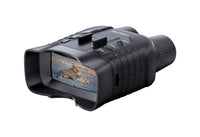
A beginner-friendly digital night vision binocular built for full-color low-light viewing, IR mode, recording, tripod use, and portable power — without a premium price tag.

Bushnell Equinox Z2 6x50
A digital night vision monocular for users who prefer a one-eye device and want longer-range tracking from an established optics brand.

SIONYX Aurora PRO
A premium full-color digital night vision monocular — technically stronger in very low light, but in a much higher price class than typical backyard gear.

Night Vision Device Comparison for Backyard Wildlife
Specs gathered directly from manufacturer pages and verified retailer listings. Where a value wasn't publicly disclosed, it's marked as such rather than guessed.

Seemor-200
Equinox Z2
Aurora PRO
AKASO Seemor-200
Two-eye comfort, 4K recording, tripod use, rechargeable batteries — strongest pick when price and simple setup matter most.
Bushnell Equinox Z2
Better fit if you specifically prefer a monocular with stronger optical-style reach over backyard-style comfort.
SIONYX Aurora PRO
The choice for users who specifically want high-end full-color night vision and are willing to pay much more for it.
AKASO Seemor-200
For most casual backyard wildlife watchers, the Seemor-200 is a practical and comfortable choice compared with many tactical-style monoculars. Its binocular design allows users to observe with both eyes, which feels more natural and reduces fatigue during longer viewing sessions. It also offers strong value for home and family use: it is easy to set up, tripod-friendly, portable, and suitable for flexible backyard placement without complicated wiring. Its full-color night vision is especially helpful for beginners because it can present a more natural-looking scene, making animals, trees, fences, feeders, and background details easier to recognize in low-light conditions.
It is also worth setting the right expectation for night vision image quality. The “4K” video from a night vision device is not the same as the bright, clean 4K footage people may expect from a daytime camera or smartphone. Because night vision works with very limited light, the image can vary depending on ambient light, distance, movement, and IR settings. In darker scenes, users may still notice noise, softer details, or motion blur. Using a tripod or stable mount can significantly reduce shake and blur, helping the device produce a cleaner and clearer image.


In captured screenshots comparing the Seemor-200 with a same-price competitor under similar night scenes, the Seemor-200 shows a more natural color reproduction, clearer fine detail, lower visible noise, and cleaner dark areas in color mode — and cleaner noise, sharper edges, and better separation around high-contrast objects in black-and-white/IR mode. This likely reflects the combined effect of sensor and image-processing chipset rather than any single spec. These are real-world reference screenshots, not a controlled lab test, but they help explain why processing quality matters as much as headline range or zoom numbers.
Bushnell Equinox Z2 6x50
A recognized optics brand positioning the Equinox Z2 as a long-range digital monocular. Its 6x magnification, 50mm objective, built-in IR, WiFi streaming, and 1080p capture suit users who want to track subjects at distance. The tradeoff: it's a one-eye device with a narrower field of view, which can feel less natural for relaxed, family-style backyard watching.
SIONYX Aurora PRO
A different price class entirely. A premium full-color monocular with a 1024×768 Micro OLED display, 60Hz frame rate, 16mm f/1.4 lens, IP67 protection, WiFi, GPS, compass, accelerometer, and sensitivity under 1 mLux in moonless starlight. Excellent for advanced users, boating, and serious low-light work — but the $999 price is hard to justify for casual backyard observation.
How to Install a Backyard Observation Setup

Use a tripod whenever possible — it steadies the image and makes it far easier to watch one area for an extended period. Place the device near a porch, window, garden edge, deck, or quiet corner of the yard, aimed toward tree lines, fences, feeders, shrubs, water sources, or open grass where animals naturally move.
A rechargeable device is easier to place because it skips outdoor wiring entirely. With the Seemor-200, that means you can test a few different locations over a week or two before settling on wherever animals actually appear most often.
How to Observe Wildlife in Your Own Backyard
Pick one spot and stay with it
Watch the same location for several evenings rather than moving around — consistency reveals patterns.
Look for signs between sessions
Tracks, disturbed leaves, feathers, droppings, and digging marks near fences and shrubs tell you who's visiting even when you miss them live.
Keep pets indoors while observing
And avoid improper feeding — it can create real health and safety problems for wild animals.
Record and review later
Short clips help beginners identify animals more accurately and catch details that are easy to miss in the moment.
The AKASO Seemor-200 Is Built for This
If your priority is comfortable two-eye viewing, sharp 4K recording, and a setup you can move anywhere in the yard — without paying premium-monocular prices — the Seemor-200 covers the fundamentals well.
- Full-color low-light + adjustable IR mode
- Up to 4K video, up to 16x digital zoom
- Tripod-ready, two rechargeable batteries included
- Weather-resistant for real outdoor use

Image & Data Sources
- Digital Camera World — AKASO Seemor-200 images, review context, and current price reference.
- Digital Camera World — Best night vision goggles and binoculars 2026, including AKASO and Bushnell Equinox Z2.
- SIONYX official Aurora PRO product page and product specification PDF.
- Original illustrative images created for this guide: full-color vs. IR comparison and tripod setup visual — educational illustrations, not official product sample images.